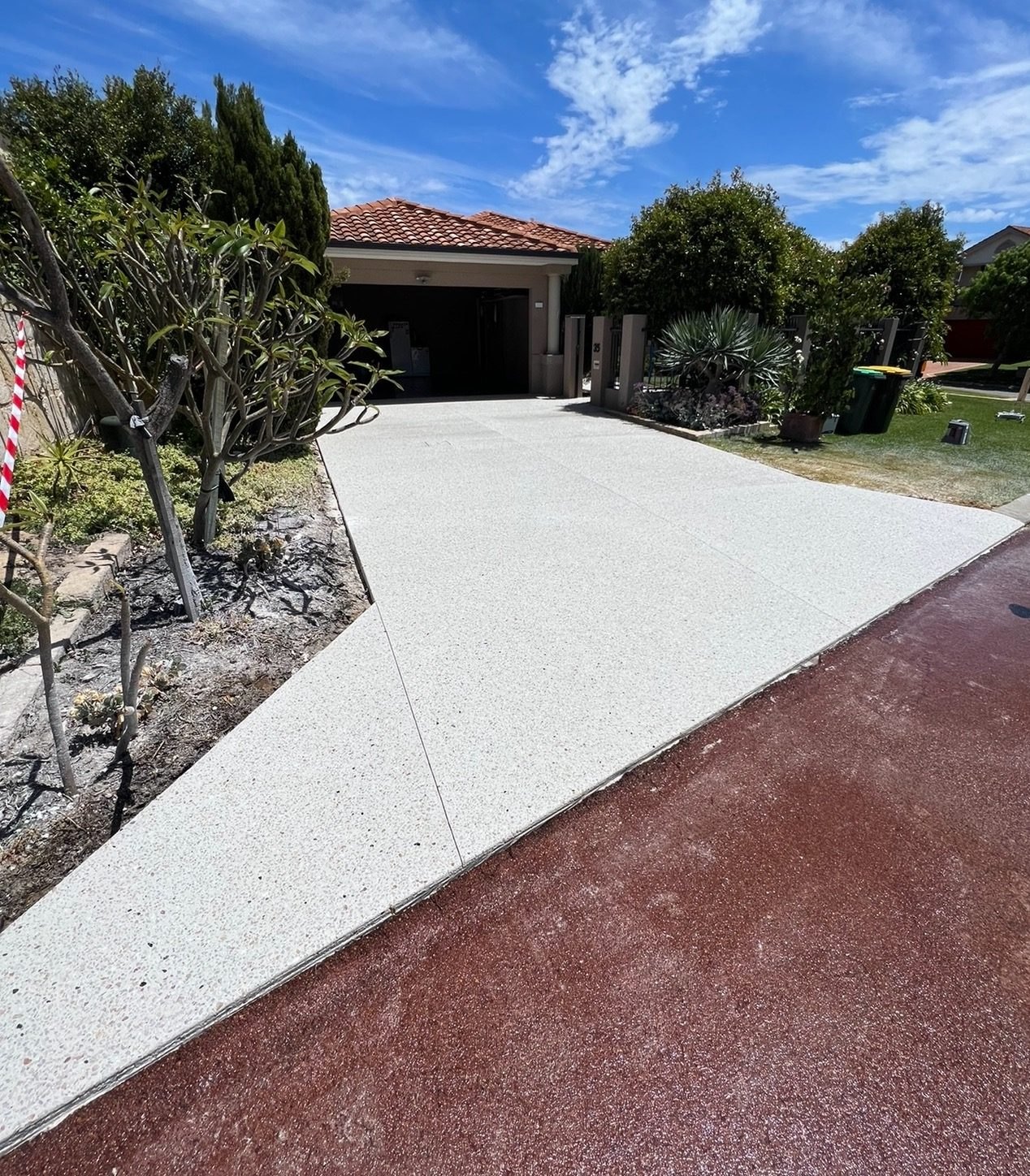
A driveway is the biggest slab most households ever pay for and the one the whole street sees. Around Maitland the work splits three ways. On the new lots of Thornton, Chisholm, Gillieston Heights, Aberglasslyn and Huntlee it is a first driveway on a handed-over house, often to replace a builder’s single strip with something two cars can share. On the older streets of Maitland, East Maitland, Rutherford and Cessnock it is a replacement, because a slab poured decades ago on river clay has cracked, dropped at the kerb or become too narrow for the cars people drive now. And everywhere in between it is a widening, so the second car comes off the grass.
Finishes and what they cost
Plain concrete, $95 to $130 per m². Grey concrete with a broom finish for grip. It is what every council in the area wants on the kerb and layback, it hides nothing and it needs nothing. For a long rural drive in Lochinvar or Greta it is usually the only sensible choice.
Coloured concrete, $115 to $160 per m². Oxide goes through the whole load, so the colour is the full depth of the slab and a chip does not show grey. It suits owners who want the driveway to sit with a dark roof or a rendered front without the texture of stone.
Exposed aggregate, $130 to $185 per m². The top is washed back to show the stone. It hides tyre marks and leaf stains, and it is the finish most estate design guidelines expect on the frontage. Stone choice, seeded versus through-mix and sealing are covered on the exposed aggregate page.
The ground decides the build
From Morpeth to Raymond Terrace the driveways that fail have one thing in common: they were poured on ground that was never prepared. Floodplain clay swells and shrinks with the seasons, and a slab laid on it without a compacted base rocks at the joints and cracks between them. On the sandy ground of Medowie and Nelson Bay the problem reverses, with edges that lose support unless they are confined. The specification sets out the base, the mesh on chairs, the thickness and the joint spacing that a quote should state, and the Hunter clay guide explains why the floodplain needs it.
The strip council owns
From the boundary to the kerb the driveway crosses public land and needs Section 138 approval before it is poured, whether it is new, widened or a like-for-like replacement. The three councils here run three different processes, from Cessnock’s Planning Portal lodgement to Maitland’s MyCouncil form and Port Stephens’ own online form, and each publishes its own fee. The Section 138 guide has all three, with the crossing standards side by side. Get the application in before the pour is booked, and have the quote state who prepares and lodges it.
Old driveway coming out
Concrete poured over a failed slab copies the failure. The old driveway is broken up, carted away and the base corrected first, which adds about $35 per m². See removal and replacement. If the same crew is on site, a side path, a patio or a shed slab poured on the same day brings every rate down.
Bracket your own driveway with the calculator, see how the figures are built in the cost guide, then ask for a measure.
Rates on this site are guide figures for planning a budget. Your price is the written quote after the concreter has seen the block, and it can sit outside the guide where ground, access or a small area call for it.